Posts

Super Bowl XLIX LED Lights

Today’s Super Bowl XLIX will be 75% more green.

This Super Bowl between the Seahawks and the Patriots will be entirely lit by LED lights in an effort to reduce energy usage by 75%.

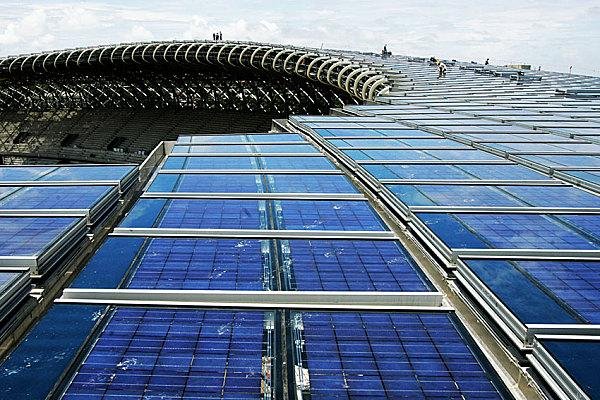
The savings come from switching from the standard metal halide lights, which are similar to incandescent lights in your home, to semiconductor based LED lights which are far more efficient, and give off far less heat. We’re very excited to hear this, and to see the initiative. Other stadiums have even gone so far as to install solar panels so they can generate power year round. With such a reduction in energy usage, it might not even be a bad idea for the University of Phoenix Stadium to install solar panels.

It looks like everyone is reading the writing on the wall from the last Super Bowl game where a blackout caused the large Metal Halide lights to cut out during part of the game.

The University of Phoenix Stadium, where the big game is being played, recently upgraded over 780 metal halide fixtures with 44,928 Cree XLamp MK-R LEDs, courtesy of Cree and Ephesus Lighting. And while it sounds like the new setup would draw far more power, it turns out those LED fixtures need a mere 310,000 watts of power to glow, compared to the 1.24 million watts required by the metal halide bulbs.

But power saving isn’t the only benefit to the stadium’s new energy-efficient lighting. The LED fixtures also produce nearly double the illumination of the old metal halide bulbs, and run at full intensity as soon as they’re switched on. If you remember the infamous Super Bowl blackout from a few years ago, it takes almost 20 minutes for metal halide bulbs to warm up and reach their full intensity.

http://gizmodo.com/the-first-super-bowl-played-under-leds-will-use-75-perc-1682559078


You won’t believe who now supports #Solar

Conservatives aren’t typically in favor of green energy, or environmental conservation. which is why one group of Tea Partiers are turning heads in Florida. The group normally concerned with the nation’s tax woes somehow has grown a soft spot for solar power. So much so in fact that they are actively seeking to cut utilities out of the game by collecting signatures for passing a constitutional amendment to allow citizens to sell their electricity to their friends and neighbors without selling it back to the utility’s grid first. Something like this would essentially bypass a century’s old system of electrical management for the open source generation of electricity and distribution. We’re really not sure how this whole thing will play out, but it’s certainly an interesting concept, and definitely something we can get behind.

http://www.washingtonpost.com/blogs/wonkblog/wp/2015/01/08/wonkbook-the-tea-party-is-pushing-for-solar-power-in-florida/

Let’s make this 4th of July #Energy Independence day

The 4th of July holds a special place on our calendars in the US,solar panel flag

It marks the day we became entirely independent, and self sufficient in all affairs.

However 1776 was a much simpler time, from sea to shining sea the land in the US was able to provide everything we could need.

But after the advent of electric power, modern plumbing, and 238 years of technological advancement we find ourselves more than ever dependent on foreign commodities like Oil.

Strategically this causes alarm, as foreign powers can ultimately raise prices on Oil, and stress our economy to the point of fracture.

We would also have little recourse other than to commit to another war to protect our infrastructure.

Why aren’t we making our own energy at home?

We have plenty of sunlight, and natural resources. We can’t afford to be dependent on foreign countries, or to commit to another war.

We need to start today, to reclaim our energy independence.

We need to install alternative energy sources in site, at home, starting this independence day.

That means solar panels, wind turbines, hydro-electric generators, whatever we can get our hands on.

Doing this, along with buying products made by American hands will bolster a stronger US economy that can compete on the world stage for the coming future.

If you’re ready to take the first step like we are,

check out our products, and pre-order our American designed and made solar panels here


Why would You ever pay anyone else for Solar Power?

Space station with Concentrated Solar panels (CSP)

In full sun there’s about 1.2Kw of energy that falls on one meter squared of land,

to put that in perspective, a typical American home uses about 1 to 2 Kw of energy instantaneously.

So with 100% efficiency you would need only a 3 foot by 3 foot solar panel to produce all the energy needed for a 1Kw home.

Unfortunately, today’s technology can produce at it’s peak a Solar cell with 20% efficiency for terrestrial (on earth) applications.

There exists some higher efficiency solar cells known as CSP’s (concentrated solar power) that can convert closer to 44% of the energy that fall on the,

they are however far more expensive than typical silicon solar cells because they have to withstand the high heat associated with concentrated solar power that’s enough to break most common solar panels.

Regardless though, the reason most people don’t have solar panels, or CSP solar panels for that matter is the high cost involved for manufacture, and installation.

The cost of solar cells is at an all time low, but to get a quote from a solar contractor, you would be lucky for a quote of around $20,000 for a 1Kw system.

Because of this, solar power has really been left up to a couple wealthy institutions, and enthusiastic home owners.

One such example is a new partnership put together by George Washington University (GW), American University (AU) and the George Washington University Hospital (GWUH)

to pay for the installation of a new 52Mw Solar Installation, which yeah, may sound like a lot of energy. It’s also a very good start in reducing carbon emissions.

However, it pales in comparison to the output by traditional coal-fired power plants.

A typical coal fired power plant produces at minimum 1,000Mw in the space of less than a square mile.

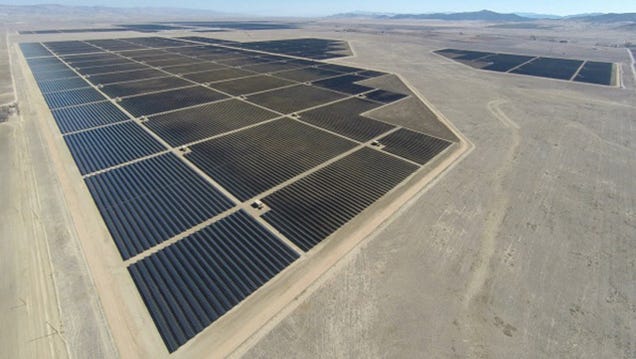
Whereas the Topaz Solar farm, the second largest completed solar farm in the world, and largest solar farm in the US produces a mere 500Mw in the space of 9.5 square miles.

At the end of the day if you had to cut down 9.5 square miles of trees, how green would your 500Mw solar farm be compared to a coal-fired one?

Topaz Solar Farm, California

Luckily the Topaz Solar farm is located in the middle of the desert, so we don’t have to answer that question.

However you should realize with a solar farm being located remotely, there are losses in transmitting the energy before you can use it.

Which amounts to about a 7% loss. That may not sound like a lot to you, but consider that that’s 7% of 500,000,000 watts.

35,000,000 watts or 35Mw of energy is just burned off, and lost in transmission before it even gets to your home.

Conversely, if those same solar panels were installed in your own backyard, there would be less than a 1% loss in energy,

and if the entire power grid went down, you would still have power.

So let’s ask the question, Why would you ever pay anyone else for solar power?

http://www.solarreviews.com/news/dc-universities-hospital-go-solar-062414/