Why is the Sunshine state cutting solar rebates?
You would think that a well positioned state in the tropics would take full advantage of an overly abundant natural resource like the sun. but to the contrary, the Sunshine state’s government has voted to slash rebates sought by homeowners for the installation of a new solar system. Such systems for homes typically cost anywhere around $30,000, and sometimes can be reduced by as much as a third to $20,000 through federal and state rebates. Homeowners also usually take out a loan to cover the other $20,000 needed to pay for the solar system. The costs and burdens are high enough with the rebates, taking them away is only going to discourage more people from investing in their own solar panels.
It almost comes as no surprise that this vote passes with the full support of Local south Florida’s power utility Florida Power & Light (FPL) As they say the rebates are unnecessary.
“Florida already ranks in the bottom half of the nation for energy efficiency, and now will only fall farther behind, costing families and businesses in the process.”But Florida Power & Light Co. and other utilities insisted their “demand-side management” programs are just one part of their conservation efforts and they remain committed to energy-efficiency.”
When they talk about Demand-side management, they are specifically talking about the energy efficiency and usage consumers have on the grid.
Saying that certain rebates are unneeded for some appliances because higher efficiency appliances are now required by federal law, they give an example that rebates for high efficiency air-conditioners are not required because: ” For example, some of their current programs – such as rebates for certain high-efficiency air-conditioners – are no longer needed, because high-efficiency equipment now is standard under new federal rules.” Yeah that might be true, but solar panels aren’t mandated by law, yet this ruling also cuts rebates for solar power.
But if getting solar panels installed is still expensive, and we’re still experiencing climate change, then why do utilities like FPL still seek to cut incentives for solar power?
In one word: profit.
If a solar panel, and a microinverter can continue to function for ten years or longer, which is now their typical mean time between failure (MTBF) then that’s ten years of power that you’re not a customer to a utility. Every solar panel is a window to a world without a central utility, they’re windows to a decentralized grid where power comes from where ever the sun is shining. Utilities know this, and they’re scared. If everyone made their own power, there would be little need for a central utility. What does FPL want instead? They want you to pay them more for your electricity so they can buy some shiny new solar panels, and sell the maintenance free electricity back to you.
“Instead of current rebates, FPL has proposed building solar-panel arrays in select neighborhoods and selling their solar energy through its grid. FPL customers could then choose to donate money toward those FPL-owned installations, but donors would get no direct benefit either from lower rates or assurances that the energy they consume comes from a solar source.”
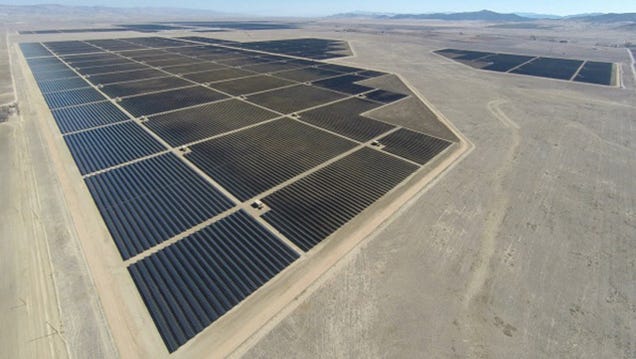
The issue with a system like this is that it’s utility scale solar power. You’ve probably seen some pictures of large fields of solar panels that stretch miles. The utility installs them, and since it’s their property these solar panels have to take up a large tract of dedicated space, which may mean clearing additional land of trees to make way for solar panels. The new solar panels would provide cleaner energy, but at the expense of efficient use of land. The alternative would be installing solar panels on your home, which you own, and they get installed on the roof instead of the ground.
Regardless of what our local government rules on,
we know we still need clean energy. But clean energy is too important to be entrusted to the utilities.
If we want it, we’re going to need to get it for ourselves.