
Space station with Concentrated Solar panels (CSP)
In full sun there’s about 1.2Kw of energy that falls on one meter squared of land,
to put that in perspective, a typical American home uses about 1 to 2 Kw of energy instantaneously.
So with 100% efficiency you would need only a 3 foot by 3 foot solar panel to produce all the energy needed for a 1Kw home.
Unfortunately, today’s technology can produce at it’s peak a Solar cell with 20% efficiency for terrestrial (on earth) applications.
There exists some higher efficiency solar cells known as CSP’s (concentrated solar power) that can convert closer to 44% of the energy that fall on the,
they are however far more expensive than typical silicon solar cells because they have to withstand the high heat associated with concentrated solar power that’s enough to break most common solar panels.
Regardless though, the reason most people don’t have solar panels, or CSP solar panels for that matter is the high cost involved for manufacture, and installation.
The cost of solar cells is at an all time low, but to get a quote from a solar contractor, you would be lucky for a quote of around $20,000 for a 1Kw system.
Because of this, solar power has really been left up to a couple wealthy institutions, and enthusiastic home owners.
One such example is a new partnership put together by George Washington University (GW), American University (AU) and the George Washington University Hospital (GWUH)
to pay for the installation of a new 52Mw Solar Installation, which yeah, may sound like a lot of energy. It’s also a very good start in reducing carbon emissions.
However, it pales in comparison to the output by traditional coal-fired power plants.
A typical coal fired power plant produces at minimum 1,000Mw in the space of less than a square mile.
Whereas the Topaz Solar farm, the second largest completed solar farm in the world, and largest solar farm in the US produces a mere 500Mw in the space of 9.5 square miles.
At the end of the day if you had to cut down 9.5 square miles of trees, how green would your 500Mw solar farm be compared to a coal-fired one?
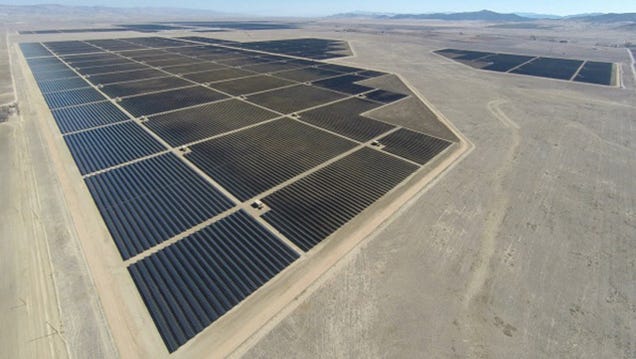
Topaz Solar Farm, California
Luckily the Topaz Solar farm is located in the middle of the desert, so we don’t have to answer that question.
However you should realize with a solar farm being located remotely, there are losses in transmitting the energy before you can use it.
Which amounts to about a 7% loss. That may not sound like a lot to you, but consider that that’s 7% of 500,000,000 watts.
35,000,000 watts or 35Mw of energy is just burned off, and lost in transmission before it even gets to your home.
Conversely, if those same solar panels were installed in your own backyard, there would be less than a 1% loss in energy,
and if the entire power grid went down, you would still have power.
So let’s ask the question, Why would you ever pay anyone else for solar power?
http://www.solarreviews.com/news/dc-universities-hospital-go-solar-062414/

