banned solar panels oklahoma
Why is the Sunshine state cutting solar rebates?
You would think that a well positioned state in the tropics would take full advantage of an overly abundant natural resource like the sun.  but to the contrary, the Sunshine state’s government has voted to slash rebates sought by homeowners for the installation of a new solar system. Such systems for homes typically cost anywhere around $30,000, and sometimes can be reduced by as much as a third to $20,000 through federal and state rebates. Homeowners also usually take out a loan to cover the other $20,000 needed to pay for the solar system. The costs and burdens are high enough with the rebates, taking them away is only going to discourage more people from investing in their own solar panels.
It almost comes as no surprise that this vote passes with the full support of Local south Florida’s power utility Florida Power & Light (FPL) As they say the rebates are unnecessary.
“Florida already ranks in the bottom half of the nation for energy efficiency, and now will only fall farther behind, costing families and businesses in the process.”
But Florida Power & Light Co. and other utilities insisted their “demand-side management” programs are just one part of their conservation efforts and they remain committed to energy-efficiency.”
When they talk about Demand-side management, they are specifically talking about the energy efficiency  and usage consumers have on the grid.
Saying that certain rebates are unneeded for some appliances because higher efficiency appliances are now required by federal law, they give an example that rebates for high efficiency air-conditioners are not required because: ” For example, some of their current programs – such as rebates for certain high-efficiency air-conditioners – are no longer needed, because high-efficiency equipment now is standard under new federal rules.” Yeah that might be true, but solar panels aren’t mandated by law, yet this ruling also cuts rebates for solar power.
But if getting solar panels installed is still expensive, and we’re still experiencing climate change, then why do utilities like FPL still seek to cut incentives for solar power?
In one word: profit.
If a solar panel, and a microinverter can continue to function for ten years or longer, which is now their typical mean time between failure (MTBF) then that’s ten years of power that you’re not a customer to a utility. Every solar panel is a window to a world without a central utility, they’re windows to a decentralized grid where power comes from where ever the sun is shining. Utilities know this, and they’re scared. If everyone made their own power, there would be little need for a central utility. What does FPL want instead? They want you to pay them more for your electricity so they can buy some shiny new solar panels, and sell the maintenance free electricity back to you.
“Instead of current rebates, FPL has proposed building solar-panel arrays in select neighborhoods and selling their solar energy through its grid. FPL customers could then choose to donate money toward those FPL-owned installations, but donors would get no direct benefit either from lower rates or assurances that the energy they consume comes from a solar source.”
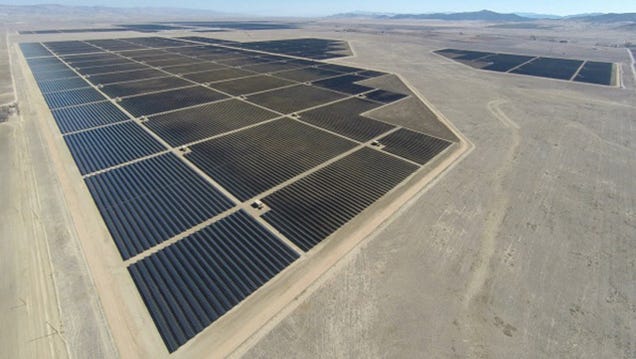
The issue with a system like this is that it’s utility scale solar power. You’ve probably seen some pictures of large fields of solar panels that stretch miles. The utility installs them, and since it’s their property these solar panels have to take up a large tract of dedicated space, which may mean clearing additional land of trees to make way for solar panels. The new solar panels would provide cleaner energy, but at the expense of efficient use of land. The alternative would be installing solar panels on your home, which you own, and they get installed on the roof instead of the ground.
Regardless of what our local government rules on,
we know we still need clean energy. But clean energy is too important to be entrusted to the utilities.
If we want it, we’re going to need to get it for ourselves.

200 People now like us on Facebook!

Our 200th new friend just liked us on Facebook, and don’t worry, the feelings are mutual! 😉

It’s pretty clear people are interested in clean energy, and we can’t wait to bring some new options to the table.

Stay tuned, we’ve got some announcements coming up soon.

Feel free to check out our feature page on our solar panels, and subscribe to our newsletter or like us on Facebook if you haven’t already for the latest updates!

Blue-sunshield-web-600

Is Climate Change Boring?

That’s the question that this YouTube video poses.
Climate change is something that will slowly continue to affect us, and our children for centuries. It may seem hard to notice the gradual change from year to year, but it’s not hard at all to see what it causes. Each year there’s more dire droughts, more horrible hurricanes, and more out of control forest fires. The scientific community has been consistent in crediting climate change to human activity. Activity that stems in large part from energy production and fossil fuel usage. It’s until we find better ways of dealing with carbon or better sources of renewable energy that climate change is going to continue to worsen.

banned solar panels oklahoma
Why on Earth would you Ban Solar Panels?

We honestly feel kind of funny asking this question.
I mean solar panels provide a means of directly converting sunshine into electricity.
Sunshine is a pretty safe thing, it’s not like uranium, plutonium, coal, or oil, yuck!
No, sunshine is safe. Maybe if you get too much of it, you’d get a sunburn.
But really unlike an oil spill which can kill tons of wildlife, you can never really get too much sunshine, have you ever heard of a “Sun spill? A sunny day, is a good day to do cool stuff outside, and a solar panel is the thing you put outside to gather all that sunlight. They’re just like the leaves of little plants, happy as can be on the sunniest day.

So why on earth would you ban Solar Panels?installing solar panels
In one word: “Profits”
Truth be told, this whole fledgling renewable energy business is a thorn in the side of the fossil fuels industry.
Solar panels, wind turbines, and hydroelectric generators are all rocking the boat.
Why would you ever go back to paying the electric company if you can buy a couple solar panels that will provide for all your electric needs, and last close to 10 or 15 years? The truth is you wouldn’t. Power, and gas companies know this. So they lobby, they pay politicians to enact, and pass some legislation making it harder for you, the environmentally, or fiscally responsible consumer to install solar panels.
Solar panels are good for you, and the environment, but they’re not good for the fossil fuels industry.
This is the reason why they’re being banned. This is the reason you might face fines for installing them.
But is this any reason to give up? Absolutely not.
Global warming isn’t quitting any time soon, and so neither are we.
This is a civil protest. Installing a solar panel in your yard, or on your roof is a big sign that you pledge allegiance to Earth, and to protect everyone else that calls it home.

So this is why, this is why it’s concerning to us to hear that Oklahoma passed legislation making people who feed their excess renewable energy back to the grid actually pay for their selfless service. While some states have a feed in tariff in place, Oklahoma actually has a feed in fee. When asked about it, Spokeswoman of the Oklahoma Gas and Electric Co. had this to say about it:

“We’re not anti-solar or anti-wind or trying to slow this down, we’re just trying to keep it fair,” Oklahoma Gas and Electric Co. spokeswoman Kathleen O’Shea told the Oklahoman. “We’ve been studying this trend. We know it’s coming, and we want to get ahead of it.”

This Map shows the effects of Climate Change in 6 years, and it’s devastating.

The effects of climate change are real, and very tangible.
This map will show you the real effects of climate change in the year 2020, within the next 6 years to come.
It’s clear we need to take steps and make investments in clean energy if we want to continue.
Is anyone else getting a sinking feeling?

Let’s make this 4th of July #Energy Independence day

The 4th of July holds a special place on our calendars in the US,solar panel flag

It marks the day we became entirely independent, and self sufficient in all affairs.

However 1776 was a much simpler time, from sea to shining sea the land in the US was able to provide everything we could need.

But after the advent of electric power, modern plumbing, and 238 years of technological advancement we find ourselves more than ever dependent on foreign commodities like Oil.

Strategically this causes alarm, as foreign powers can ultimately raise prices on Oil, and stress our economy to the point of fracture.

We would also have little recourse other than to commit to another war to protect our infrastructure.

Why aren’t we making our own energy at home?

We have plenty of sunlight, and natural resources. We can’t afford to be dependent on foreign countries, or to commit to another war.

We need to start today, to reclaim our energy independence.

We need to install alternative energy sources in site, at home, starting this independence day.

That means solar panels, wind turbines, hydro-electric generators, whatever we can get our hands on.

Doing this, along with buying products made by American hands will bolster a stronger US economy that can compete on the world stage for the coming future.

If you’re ready to take the first step like we are,

check out our products, and pre-order our American designed and made solar panels here


Why would You ever pay anyone else for Solar Power?

Space station with Concentrated Solar panels (CSP)

In full sun there’s about 1.2Kw of energy that falls on one meter squared of land,

to put that in perspective, a typical American home uses about 1 to 2 Kw of energy instantaneously.

So with 100% efficiency you would need only a 3 foot by 3 foot solar panel to produce all the energy needed for a 1Kw home.

Unfortunately, today’s technology can produce at it’s peak a Solar cell with 20% efficiency for terrestrial (on earth) applications.

There exists some higher efficiency solar cells known as CSP’s (concentrated solar power) that can convert closer to 44% of the energy that fall on the,

they are however far more expensive than typical silicon solar cells because they have to withstand the high heat associated with concentrated solar power that’s enough to break most common solar panels.

Regardless though, the reason most people don’t have solar panels, or CSP solar panels for that matter is the high cost involved for manufacture, and installation.

The cost of solar cells is at an all time low, but to get a quote from a solar contractor, you would be lucky for a quote of around $20,000 for a 1Kw system.

Because of this, solar power has really been left up to a couple wealthy institutions, and enthusiastic home owners.

One such example is a new partnership put together by George Washington University (GW), American University (AU) and the George Washington University Hospital (GWUH)

to pay for the installation of a new 52Mw Solar Installation, which yeah, may sound like a lot of energy. It’s also a very good start in reducing carbon emissions.

However, it pales in comparison to the output by traditional coal-fired power plants.

A typical coal fired power plant produces at minimum 1,000Mw in the space of less than a square mile.

Whereas the Topaz Solar farm, the second largest completed solar farm in the world, and largest solar farm in the US produces a mere 500Mw in the space of 9.5 square miles.

At the end of the day if you had to cut down 9.5 square miles of trees, how green would your 500Mw solar farm be compared to a coal-fired one?

Topaz Solar Farm, California

Luckily the Topaz Solar farm is located in the middle of the desert, so we don’t have to answer that question.

However you should realize with a solar farm being located remotely, there are losses in transmitting the energy before you can use it.

Which amounts to about a 7% loss. That may not sound like a lot to you, but consider that that’s 7% of 500,000,000 watts.

35,000,000 watts or 35Mw of energy is just burned off, and lost in transmission before it even gets to your home.

Conversely, if those same solar panels were installed in your own backyard, there would be less than a 1% loss in energy,

and if the entire power grid went down, you would still have power.

So let’s ask the question, Why would you ever pay anyone else for solar power?

http://www.solarreviews.com/news/dc-universities-hospital-go-solar-062414/

‘Energetic Bear’ malware targets US Power plants

As tensions continue to rise in the world, infrastructure continually gets targeted.

Energy is a vital resource, and a critical part of any infrastructure.

It’s no wonder why hackers are now targeting US power plants.

Except perhaps that this latest attack may have been conducted with the support from the Russian government amid recent regional conflicts, and UN sanctions against Russia.

Dragonfly bears the hallmarks of a state-sponsored operation, displaying a high degree of technical capability.  The group is well resourced, with a range of malware tools at its disposal and is capable of launching attacks through multiple attack vectors while compromising numerous third party websites in the process. Its main motive appears to be cyber espionage, with potential for sabotage a definite secondary capability.

‘Energetic Bear’ is not the first attack to target US infrastructure, several other malicious programs have tried doing similar things in the past.

This only stands as further proof that what’s needed is a decentralized grid, that’s energy efficient, independent, but collaborative.

Alternative energy sources like Solar, wind, and hydro stand at the forefront of a decentralized, and reliable power grid.


http://www.symantec.com/connect/blogs/emerging-threat-dragonfly-energetic-bear-apt-group

Wyatt Sanders, CEO, Founder, and Inventor at Insite Renewables

Wyatt moved to Jacksonville from Palm Beach after graduating Suncoast Highschool to attend UNF for a degree in electrical engineering. In the course of his studies he became involved with campus life starting two clubs on campus, he then left to start Jacksonville’s first Makerspace called Jaxhax. He was then hired as a draftsman and Intern at Industrial Power Systems (IEM) and has since learned a great deal about the electrical manufacturing industry. In his private studies he had a moment of genius that lead to his development of Solar Shutters and later founding Insite Renewable Energy, LLC. At the time of writing this, he is currently a board member for Jaxhax, Inc. Part-time Student at UNF, and CEO and Inventor at Insite Renewable Energy, LLC.